
You've done the work. You've sat in the therapist's chair. You've read the books, filled out the worksheets, learned to "reframe" your thoughts, identified your "parts," practiced the breathing exercises. You can explain your childhood trauma better than most licensed clinicians.
And you still feel stuck.
Not stuck like you haven't tried. Stuck like you've tried everything and you're starting to wonder if maybe you're the problem. Maybe you're just too damaged. Too far gone. Maybe everyone else gets better and you're the one person who can't.
That voice — the one telling you that right now — isn't the truth. It's your shame talking. And the reason you still feel stuck after all that work is not because you're broken. It's because every approach you've tried has been working around the two things that actually keep you trapped: shame and denial.
No one taught you how to confront them directly. Not because they didn't care but because most frameworks aren't built to go there.
This article is going to show you why. And it's going to show you what actually works — not because I said so, but because the neuroscience backs it up.
The Pattern You're Ashamed Of (But Can't Seem to Stop)
You know the feeling. Something triggers you — a tone of voice, a perceived rejection, a moment where you felt unseen — and before you can catch yourself, you're gone. You're reactive. You're shutting down. You're people-pleasing. You're rage-texting. You're dissecting a three-sentence conversation for the next six hours.
And then the shame hits. Why did I do that again? I know better than this. What is wrong with me?
What You Do
You overfunction. Or you collapse. Or you perform calm while your nervous system screams. You rehearse conversations in the shower. You say "I'm fine" while your chest is on fire. You feel five years old trying to negotiate an adult relationship.
What Your Body Tells You
Tight throat. Clenched jaw. Heat in your chest. Heaviness in your stomach. That frozen, hollow feeling where you can't access any words — or the opposite, where the words pour out and you can't stop them. Your body remembers what your mind has filed away.
What Your Blueprint Decided
Somewhere in childhood, your emotional blueprint wrote a rule: Love means I have to perform. Safety means I can't have needs. Belonging means I abandon myself. That rule is still running. Every reaction you're ashamed of is that program executing on schedule.
You're not broken. You're programmed. And you've been trying to fix the program with tools that can't reach it.
What's Really Going On Underneath: Your Emotional Blueprint and the Worst Day Cycle
Here's what nobody told you in therapy: the pattern you can't stop isn't a behavior problem. It's not a thinking problem. It's a blueprint problem.
Your emotional blueprint was installed in childhood — before you had language, before you had logic, before you had any capacity to evaluate whether the rules being written were true or fair. Your brain absorbed the emotional environment you grew up in and created automatic programs to keep you safe within it.
How the Worst Day Cycle Keeps the Program Running
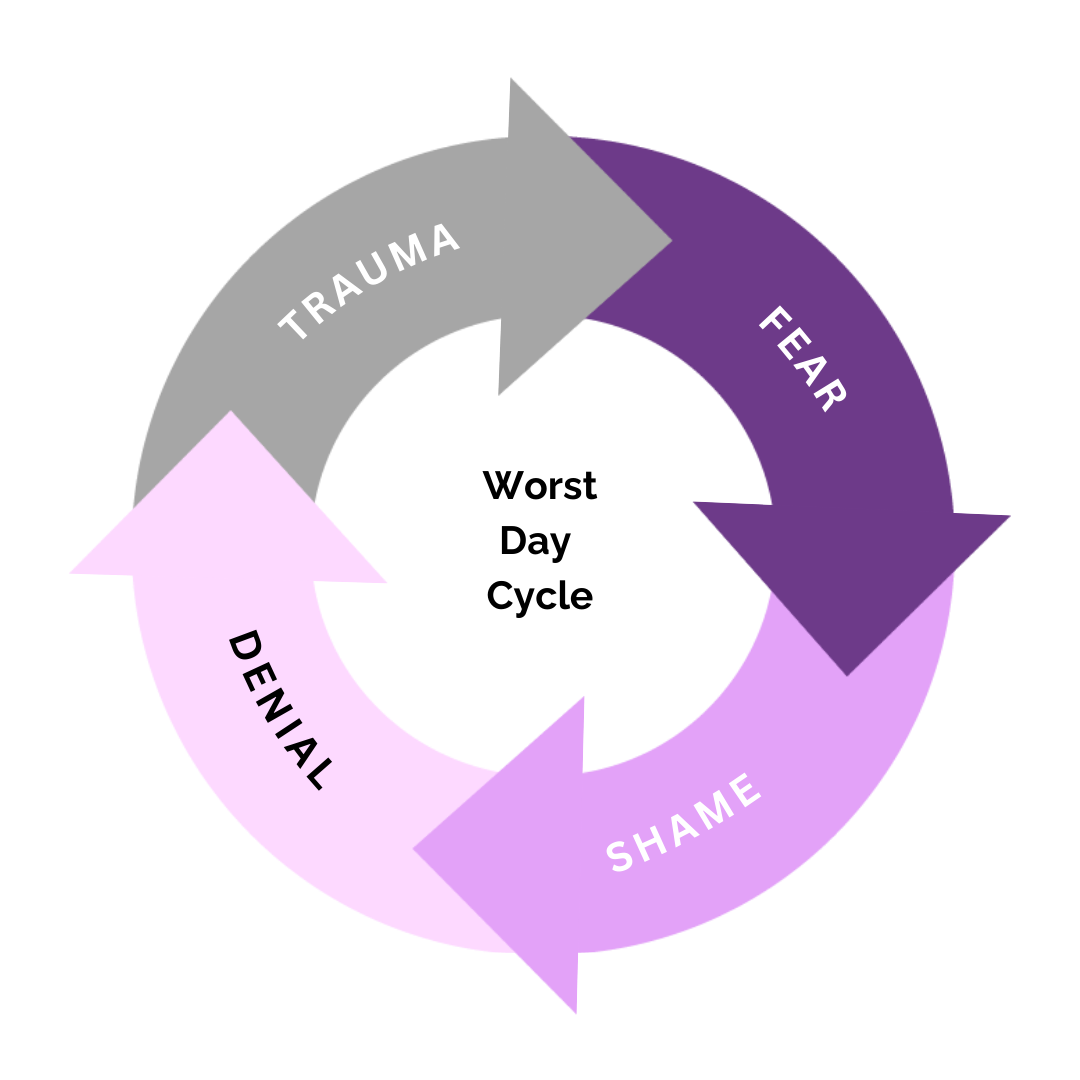
Something happened to you. It created fear. That fear crystallized into shame — the deep, wordless belief that something is fundamentally wrong with you, not with what happened. And because shame is unbearable, your brain created denial and self-deception to keep you from having to feel it.
This is what some call your ego or your shadow. It's the mask your brain built in childhood to protect you from the pain shame creates.
The Survival Persona
Your Survival Persona isn't a villain. It kept you alive. But it was built by a child, for a child's world. And now it's running your adult life — your relationships, your career, your parenting, your self-worth — using rules that were never true and strategies that no longer serve you.
And here's the devastating part: every framework you've tried has been bumping up against this cycle without naming it. They've been trying to change your thoughts, regulate your nervous system, or re-parent your inner child — all while shame and denial sat untouched underneath, quietly running the show.
Why CBT, IFS, Talk Therapy, and Self-Help Books Haven't Gotten You Unstuck
This isn't about bashing other approaches. Many of them have value. But if you've invested years in therapy, coaching, or personal development and you're still cycling through the same patterns, you deserve to understand why — so you can stop blaming yourself for something that was never your fault.
Why CBT Falls Short for Childhood Trauma Recovery
Cognitive Behavioral Therapy is the most widely recommended therapeutic approach in the world. It works by identifying negative thought patterns and replacing them with healthier ones. For mild anxiety and situational depression, it can be genuinely helpful.
But here's the problem: CBT assumes you can think your way to change. And trauma doesn't live in your thoughts — it lives in your body, your nervous system, and your subconscious emotional blueprints. Research published in the National Institutes of Health shows that CBT nonresponse rates for PTSD can be as high as 50%. That means half the people going through the gold-standard treatment aren't getting better.
Why? Because CBT targets the content of your thoughts without addressing the subconscious programming that generates those thoughts. It's like trying to fix a software glitch by editing what's on the screen instead of rewriting the code.
Why IFS Parts Work Can Create More Fragmentation, Not Less
Internal Family Systems therapy has exploded in popularity. It breaks your psyche into "parts" — managers, firefighters, and exiles — and teaches you to have conversations with them. For some people, this offers initial relief and a useful language for their inner experience.
But there are serious concerns. The Society for the Advancement of Psychotherapy has noted that IFS has a strikingly small evidence base despite being developed over 30 years ago, and there are documented cases of it exacerbating splitting of self-states.
Think about that for a moment. A framework designed to help you heal can actually make you more fragmented. More dependent on the model. More disconnected from a unified sense of who you are.
The Authentic Self Cycle does the exact opposite. Instead of breaking you into parts and negotiating between them, it builds a single, integrated pathway: Truth → Responsibility → Healing → Forgiveness. You don't need a therapist to "talk to your parts." You develop the capacity to observe, own, and rewrite your own programming.
Why Talk Therapy Keeps You Comfortable but Doesn't Change You
Traditional talk therapy can provide validation, insight, and a safe relationship — all of which matter. But validation without confrontation is comfort without change. If your therapist never challenges your denial, never names your shame, never asks you to take ownership of the patterns you're running — you'll feel heard, but you won't heal.
You can spend a decade in therapy learning why you are the way you are, without ever changing how you are. That's not a failure of effort. That's a failure of framework.
The Emotional Authenticity Shift: What Actually Rewires Your Brain
Emotional Authenticity activates metacognition — the highest form of human intelligence. When you practice it, you engage your anterior prefrontal cortex, the part of your brain that isn't designed for action or emotion. It's designed for self-observation.
This is not mindfulness. This is not meditation. This is not "being present." This is a directed, specific neurological process that allows you to turn your attention inward and interrupt the automatic, subconscious emotional blueprints that have been running your life without your permission.
You're Using Your Brain's Hardware to Edit Its Own Software
Neuroscience research confirms that metacognitive practice supports neuroplasticity — the brain's ability to rewire itself in response to experience. Over time, repeated metacognitive practice strengthens new neural pathways that support clarity, calm, and resilience.
But Emotional Authenticity doesn't just build general awareness. It aims that awareness at the two specific forces that block all real change:
- Shame — the invisible weight you've been carrying since childhood
- Denial and self-deception — what some call your ego or your shadow — the part of you that distorts reality to avoid the pain shame creates
The Three Questions That Change Everything
Emotional Authenticity asks three deceptively simple questions:
- What am I feeling right now?
- Where in my body do I feel it?
- What is my earliest memory of having this feeling?
These questions bypass your intellect and go straight to the blueprint. They activate the anterior prefrontal cortex for self-observation while simultaneously connecting you to the somatic and emotional data your subconscious has been hiding from you.
That third question — what is my earliest memory of having this feeling? — is the one that most frameworks are too afraid to ask. Because the answer always leads to childhood. It always leads to the wound. And it always leads to shame.
And that's exactly where you need to go.
The Authentic Self Cycle: The Pathway That Replaces the Pattern
Once Emotional Authenticity creates recognition — once you see the blueprint, feel it in your body, and trace it to its origin — the Authentic Self Cycle gives you a pathway forward:
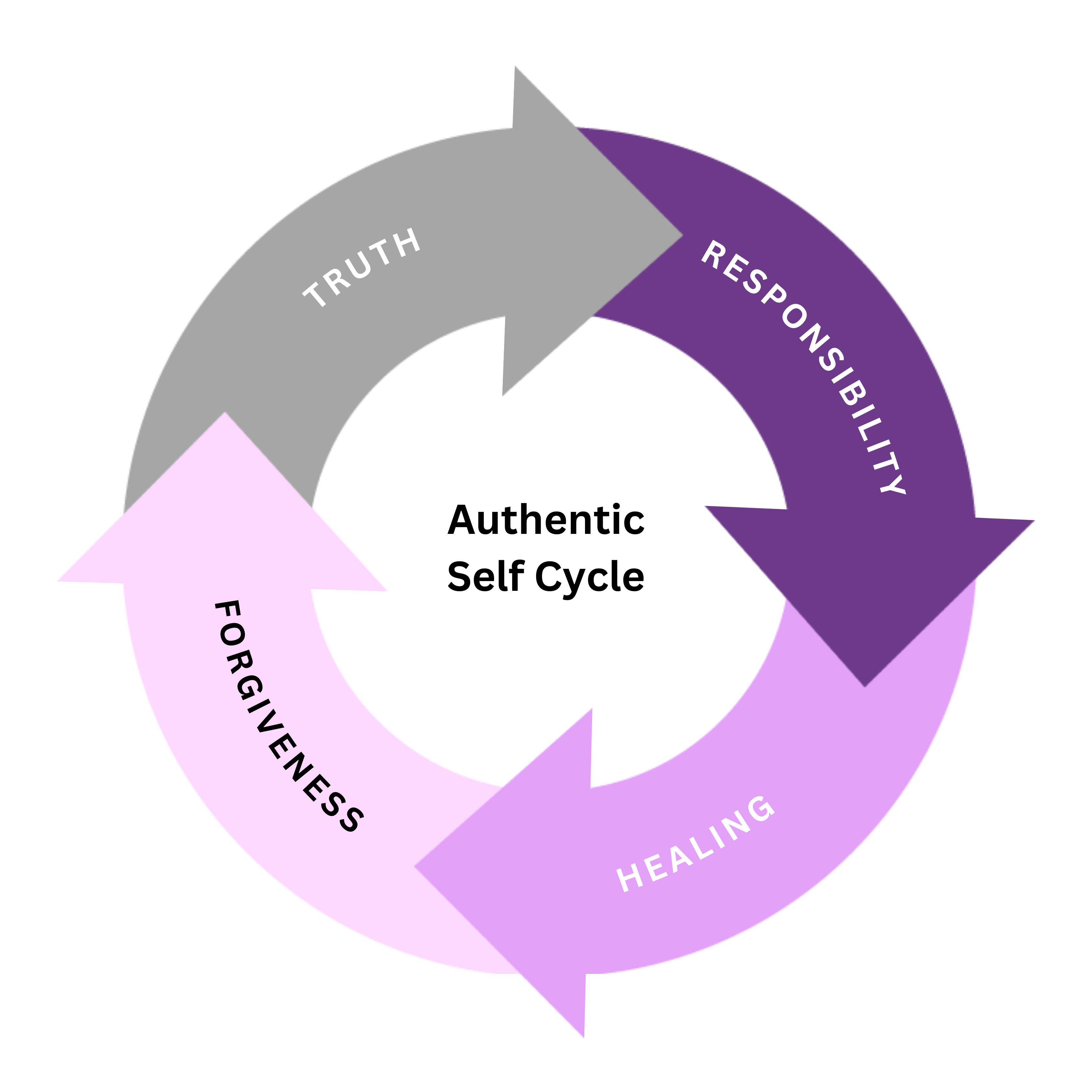
Truth means looking at yourself honestly and owning your part. Not to punish yourself — but to stop defending what isn't working.
Responsibility means accepting your failures and your perfect imperfections without shame. It means choosing to stop running from the pattern and start owning it.
Healing becomes possible because you've stopped fighting reality. You've stopped letting denial protect you from the very thing you need to confront.
And forgiveness doesn't have to be forced. When truth, responsibility, and healing are present, forgiveness arrives naturally — because you've finally earned it from the only person whose forgiveness ever mattered: yourself.
What This Looks Like in Real Life
Before Emotional Authenticity
Your partner says something dismissive at dinner. Within seconds, your chest tightens. Your jaw locks. You either shut down completely or launch into a counterattack you'll regret by midnight. Later, alone, you replay the conversation for hours — finally thinking of what you wish you'd said. You tell yourself you overreacted. You feel ashamed. You promise yourself you'll "do better next time." The cycle continues.
After Emotional Authenticity
Your partner says the same thing. Your chest tightens. But this time, you notice it. What am I feeling? Rejected. Unseen. Where do I feel it? My chest. My throat. What's my earliest memory of this feeling?
And there it is. You're not reacting to your partner. You're reacting to a six-year-old wound that just got activated. The blueprint fired. But for the first time, you caught it while it was running instead of after the damage was done.
That pause — that moment of metacognitive self-observation — is everything. It's the moment where the old software stops running and the new programming begins.
Why This Combination Outperforms Every Other Trauma Recovery Framework
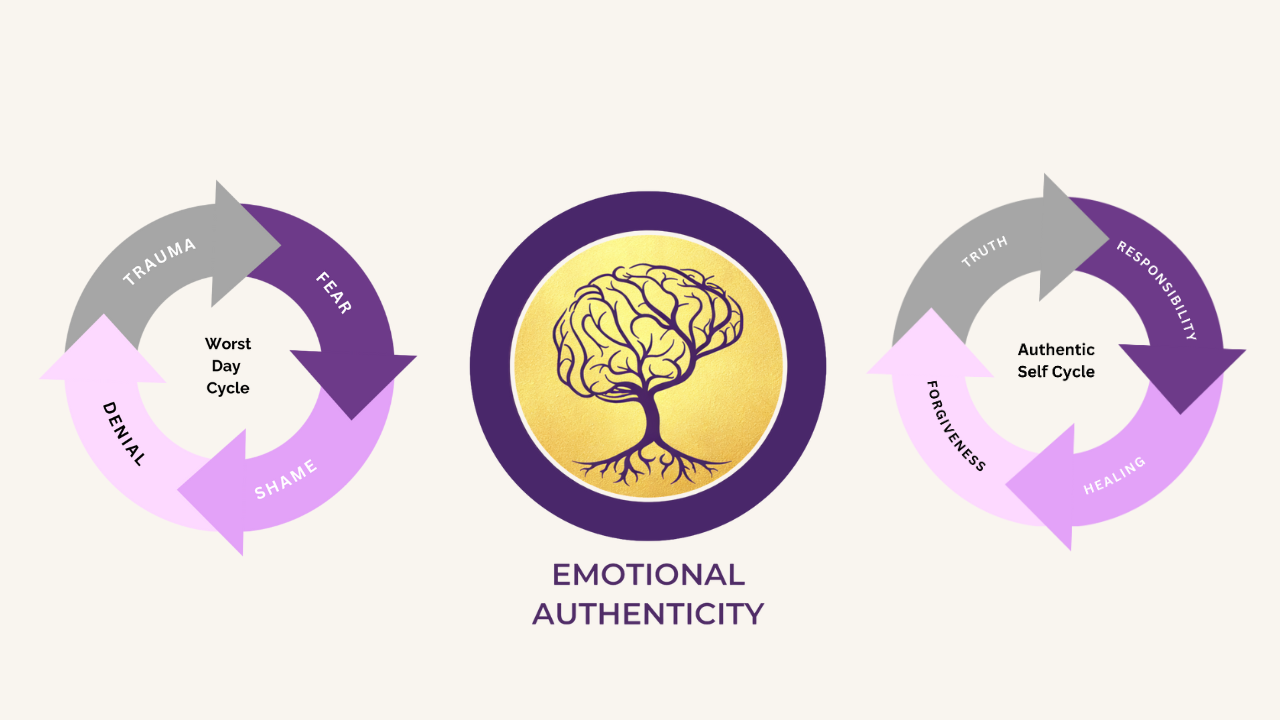
No single framework in the current trauma recovery landscape combines all of the following elements. This is what makes Emotional Authenticity and the Authentic Self Cycle fundamentally different:
- It Activates the Right Part of the Brain
CBT targets the cognitive functions. Somatic work targets the body. Emotional Authenticity targets the anterior prefrontal cortex — the brain region specifically designed for self-observation, not action or emotion. - It Confronts the Two Actual Blockers of All Change
Shame and denial are not symptoms. They are the gatekeepers of every pattern you can't break. Emotional Authenticity confronts both head-on. - It Builds Integration Instead of Fragmentation
IFS breaks you into parts. Emotional Authenticity builds you into a whole. The Authentic Self Cycle creates a unified pathway that strengthens your capacity to lead your own internal system. - It Leverages Neuroplasticity Through Directed Metacognition
You're not just observing — you're observing the exact thing your brain is designed to hide from you. - It Follows the Brain's Natural Learning Sequence
Emotional Authenticity leads with recognition — creating the "that's me" moment that activates the anterior prefrontal cortex before teaching lands. - It Provides a Complete, Sequential System — Not Just a Technique
A repeatable, sequential process that works whether you're dealing with relationship patterns, career self-sabotage, parenting triggers, or childhood shame.
Frequently Asked Questions
Why does therapy not work for childhood trauma?
Many traditional therapy approaches focus on changing thoughts or managing symptoms without addressing the subconscious emotional blueprints installed in childhood. These blueprints operate beneath conscious awareness, driven by shame and denial — two forces that most therapeutic models work around rather than confront directly.
What's the difference between CBT and Emotional Authenticity for trauma?
CBT tries to replace negative thoughts with healthier ones. Emotional Authenticity doesn't try to change your thoughts at all — it activates the anterior prefrontal cortex for self-observation, allowing you to interrupt the subconscious programs that generate those thoughts.
Is IFS therapy effective for trauma recovery?
IFS can offer initial relief and useful language for inner experience. However, the evidence base remains limited, and clinical observers have noted that parts work can create fragmentation rather than integration. The Authentic Self Cycle takes the opposite approach.
How does metacognition help heal trauma?
Metacognition activates the brain region designed for self-observation rather than reaction. This supports neuroplasticity — the brain's ability to rewire itself. Emotional Authenticity uses directed metacognition aimed specifically at shame and denial.
Why do I keep repeating the same patterns even after years of personal development?
Because the pattern isn't a behavior problem or a thinking problem — it's a blueprint problem. The Worst Day Cycle keeps running beneath conscious awareness. Until you confront shame and denial directly, every other intervention will only address the surface.
Your Next Small Step
You don't have to overhaul your life today. You don't have to sign up for anything or commit to a program. You just have to try one thing.
The next time you feel triggered — the next time your chest tightens, your throat closes, or you hear that familiar inner voice telling you you're not enough — pause. And ask yourself three questions:
- What am I feeling right now?
- Where in my body do I feel it?
- What is my earliest memory of having this feeling?
You don't have to do anything with the answer. Just notice it. That's Emotional Authenticity. That's your anterior prefrontal cortex coming online. That's the moment the old software pauses and the new programming has a chance to begin.
One moment of directed self-observation. That's all it takes to start interrupting decades of automatic programming.
When You're Ready to Go Deeper
If something in this article made you think "Oh my God, that's me" — that recognition is the beginning. Not the end.
Kenny Weiss has spent decades developing the Emotional Authenticity Method™, the Worst Day Cycle™, and the Authentic Self Cycle™ into a complete system for people who've tried everything and still feel stuck. His two books — Your Journey to Success and Your Journey to Being Yourself — go deeper into these frameworks. His courses at The Greatness U walk you through the full process, from recognition to rewiring.
You're not broken. You were never broken. You were programmed — and now you have a framework that can actually reach the programming.
Your authentic self has been waiting. It's time to hear it.